I build backend services and cloud architecture. I'm passionate about solving problems, building algorithms and designing systems that scale. I enjoy working with distributed systems, and I have a strong interest in programming languages and compilers.
At Adobe my team and I maintain four production services that millions of people use every day. I own and plan the migration of a production data pipeline on our GitOps-based Kubernetes platform, and I'm heavily invested in my team's (AI) tooling.
Beyond work I build or contribute to software I use daily. I'm a contributor to Dux Shell, a Linux Wayland shell, and I also maintain devline, my own Claude Code plugin.
As my bachelor thesis at the University of Hamburg I built BPMNscript, a programming language for executable business process models in the BPMN 2.0 standard. The B.Sc. in Information Systems at the University of Hamburg, with an exchange year at San Diego State University, will be completed in December 2026, and in January 2027 I start a part-time M.S. in Computer Science at the Georgia Institute of Technology.
I'm a working student on a team in Adobe Cloud Platform and Collaboration (ACPC). We run four event-driven Java services on AWS that millions of people use across Adobe, for example for commenting, sharing, search suggestions and an asset storage layer. Besides development, deployments and code reviews, I own the move of a production pipeline to GitOps on Kubernetes and initiated my team's shared AI tooling and skills.
Read more
What I did
Own the migration of a production pipeline from Spring Cloud Data Flow to our internal GitOps-based platform built on Kubernetes, end to end. I mapped the poorly documented system, developed the migration plan to move 10 partly stateful services securely and without downtime, and refined it with senior engineers into a 4-month roadmap.
The hardest piece is a stateful app that neither backup could fully restore. I moved its state onto a Kafka Streams changelog, so it survives failures, scales out across instances and rebuilds its smaller state faster.
Started the team's repo of AI agent skills for maintenance and repeated tasks. Helped build the team's AI harness: context and information on testing, CI/CD, architecture, our environment and connected services, for agents and developers alike.
Contributed to a multi-region CI/CD pipeline for new AWS regions and extended monitoring with Splunk, Grafana and New Relic. The services run on EKS, MSK, Aurora, Neptune, OpenSearch, SQS and S3, with more than 30 production deployments so far.
Cleaned up tech debt in multiple services: bug fixes, unified CI/CD (Jenkins, Argo Workflows) and secrets handling, major breaking upgrades and a large security backlog.
Fixed bugs I discovered, like a race in which concurrent CI and release runs could ship unreviewed builds to production, and a years-old account-linking bug that a misconfigured test had hidden.
Teaching Assistant, Software Engineering II Hamburg, Germany
Apr 2026 – Jul 2026
Tutor for Software Engineering II in the summer semester. I ran a weekly lab group, helped students and graded solutions, and took turns live coding in the lecture.
Read more
What I did
Ran a tutor group in the weekly exercise session, about two hours a week: answered questions, gave hints when students were stuck, and corrected and graded their solutions.
Took turns with two other tutors supporting the lecture with live coding in front of several hundred students. I showed the lecture material in practice and adapted to questions.
My cross-functional team at OTTO owned product-data onboarding and its integrations, and I built and maintained Java microservices for it, from architecture and development to testing and deployment.
Read more
What I did
Built Java and Spring Boot microservices in hexagonal architecture, connected by event-driven data flows over Kafka, on AWS (ECS, Lambda, S3, CloudWatch) with MongoDB and Terraform.
Designed and introduced an AI-assisted development setup for the team, replacing generic GitHub Copilot: AI code reviews and custom agents tuned to our team's workflows and conventions.
Helped build a media asset service that consumes product-data events from Kafka, validates them, prepares uploads to a downstream media system and reconciles the media assets with that system.
Migrated a production service to a new, structurally different Kafka without downtime.
Took part in architecture planning and design decisions, refinement and planning, built CI/CD pipelines with GitHub Actions, maintained a React frontend and patched vulnerabilities.
msg.Pension Data is a standard product that delivers pension data to a central government service. As the only German developer on it, I was the link between our German product managers and client communication on one side and the Slovenian development team on the other, and I tested, documented and developed the product in Java and Vue.js.
Read more
What I did
Turned client communication into technical requirements and checked them against regulatory requirements.
Owned API and functional testing: designed, ran and documented tests with Postman and Jenkins, plus manual QA and code reviews.
Worked through Jira user stories and grew from small fixes to larger bugs and features in Java (Spring Boot) and the Vue.js frontend.
Designed and built a documentation-as-code pipeline as my first standalone project, and reviewed and extended the product documentation.
20232024202520262027
Nov 2026
Workmsg.lifeOTTOTeaching AssistantAdobeEducationUniversity of Hamburg, B.Sc.San Diego State University, Exchange yearGeorgia Institute of Technology, M.S.
Work and education over time
Entry
Period
Work
msg.life, Software Engineer (Working Student)
Oct 2023 – Jul 2024
OTTO, Software Engineer (Working Student)
Aug 2025 – Jun 2026
Teaching Assistant, Teaching Assistant, Software Engineering II
Exchange year in Computer Science, August 2024 to May 2025, with a GPA of 3.87 (US scale; best: 4.0).
BPMNscript
BPMN
The standard notation for business processes: tasks, decisions and the paths between them, drawn as a diagram that a process engine can run.
Who uses it
Business analysts draw the processes, developers make them run on an engine such as Operaton, and the people in charge of a process monitor it.
BPMNscript
My text notation for the same diagrams. An if replaces the drawn diamond, so developers write, review and merge a process like any other code.
The compiler turns BPMNscript into BPMN XML that Operaton runs as is, and the importer reads existing BPMN XML back into code. Developers keep the tools they know from code: line diffs, completion and errors while typing. When the importer can't represent a model, it refuses it or warns, so a process doesn't change unnoticed.
invoice-approval.bpmnscriptSourceDiagramXML
processinvoice-approval{startReviewStart{form{ amount: number "Invoice amount"}}userReviewInvoice(assignee: "demo")if(amount > 1000){userSeniorApproval(assignee: "manager")}else{serviceAutoApprove(class: "com.example.invoice.AutoApproveDelegate")}endDone}
Start: Review Start.
User task: Review Invoice.
Decision: if the amount is greater than 1000, go to Senior Approval, a user task.
The evaluation checks whether a real process comes back unchanged from a trip into BPMNscript and back. Each model went through these steps:
Collect real models. BPMN files from public GitHub projects, listed in a dataset by Türker et al. (2022). None of them are mine.
Deploy the original. Operaton has to deploy the original, or the model doesn't count.
Import into BPMNscript. The importer turns the model into code, or refuses it with an error that names the construct it can't write, such as a connector to an external service.
Compile back to BPMN. The compiler turns that code into a new BPMN file.
Compare and deploy again. The new file has to match the original in its flows, conditions, task settings and names, and Operaton has to deploy it.
6,060 models deploy
81.6%
4,946 accepted
1,114 refused, each with an error that names the construct
78.0%
3,858 come back equivalent and deploy
1,088 come back different, or the tool fails on them
Figure 1 3,858 of the 4,946 accepted models (78.0%) came back as the same process, 63.7% of all 6,060 deployed. Small models fare best: 77.3% of those with up to 10 elements come back equivalent, against 5.9% of those with more than 50.
Read more
What I did
Designed the language and wrote the compiler and the importer (TypeScript, Langium) for my bachelor thesis. The compiler turns structured blocks into BPMN 2.0 XML, and the importer restructures arbitrary process graphs into blocks with dominator analysis.
A VS Code language server and a command-line tool come from the same code base.
Evaluated the round trip in a reproducible pipeline: 2,000 fuzz-generated programs, each in three element orderings, and 6,000+ mined real-world models, each deployed to Operaton in Docker.
Why it mattered Of the 6,060 mined models that Operaton deploys, the importer accepts 4,946 and refuses 1,114. 78.0% of the accepted ones round-trip to an equivalent model.
Dux Shell
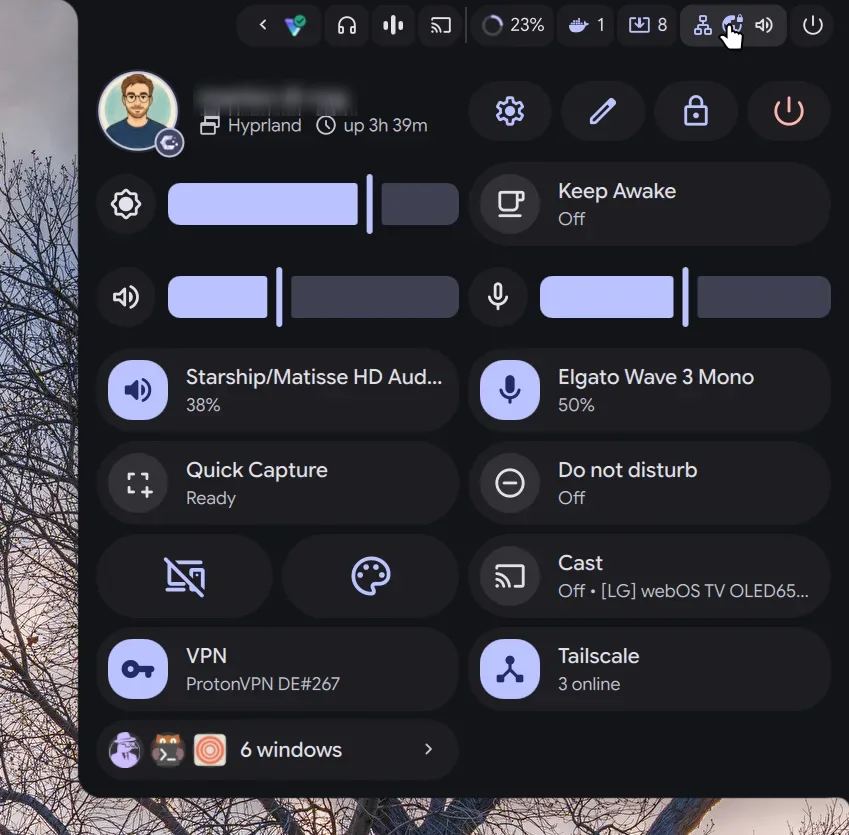
Dux is a desktop shell for Wayland compositors, written in Go and QML on Quickshell. I'm a contributor: I build larger features, fix bugs, investigate issues, help users and take part in design discussions. I also build plugins and apps for it, among them a music player. 110 merged pull requests in 7 repositories, 17 open.
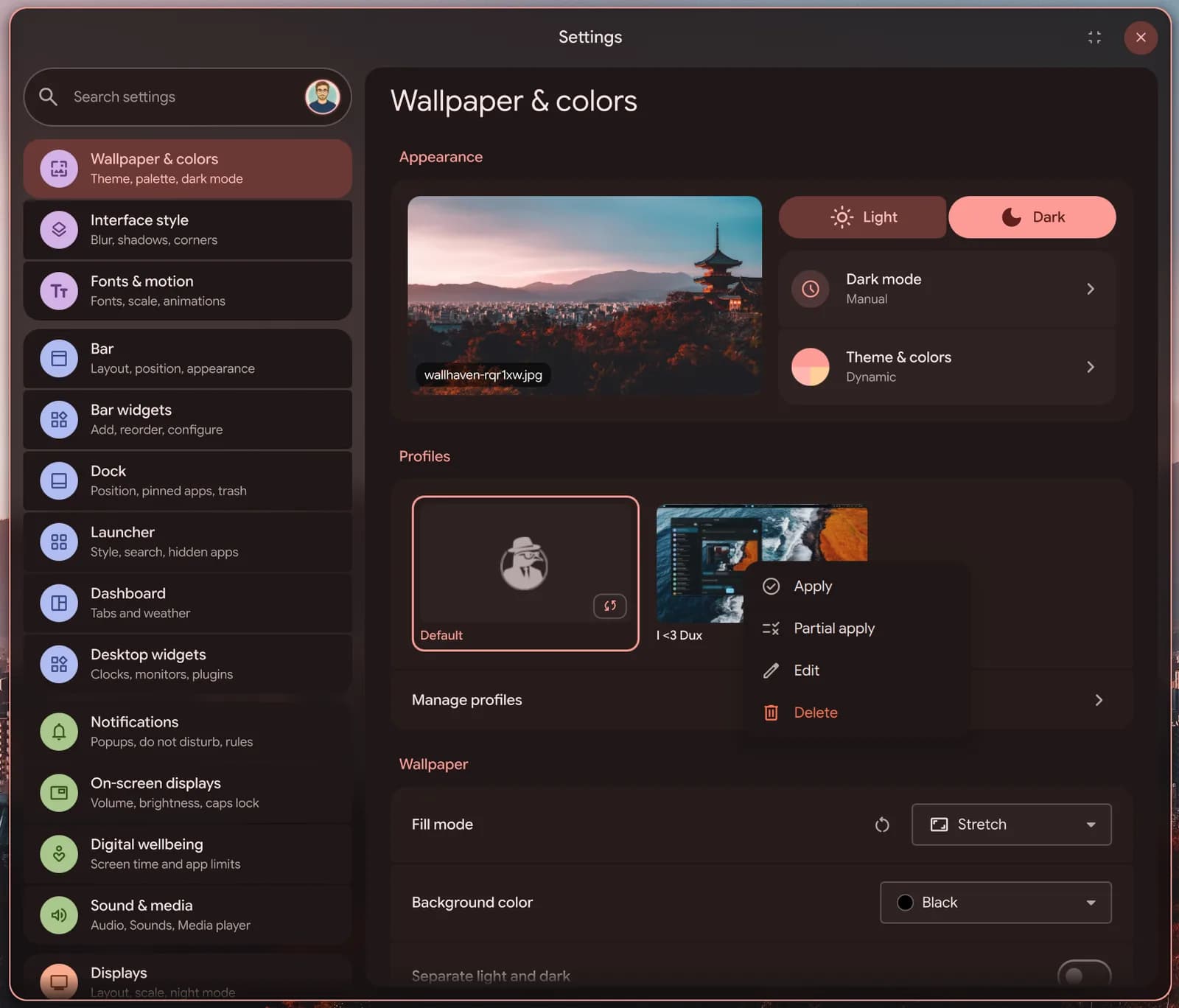
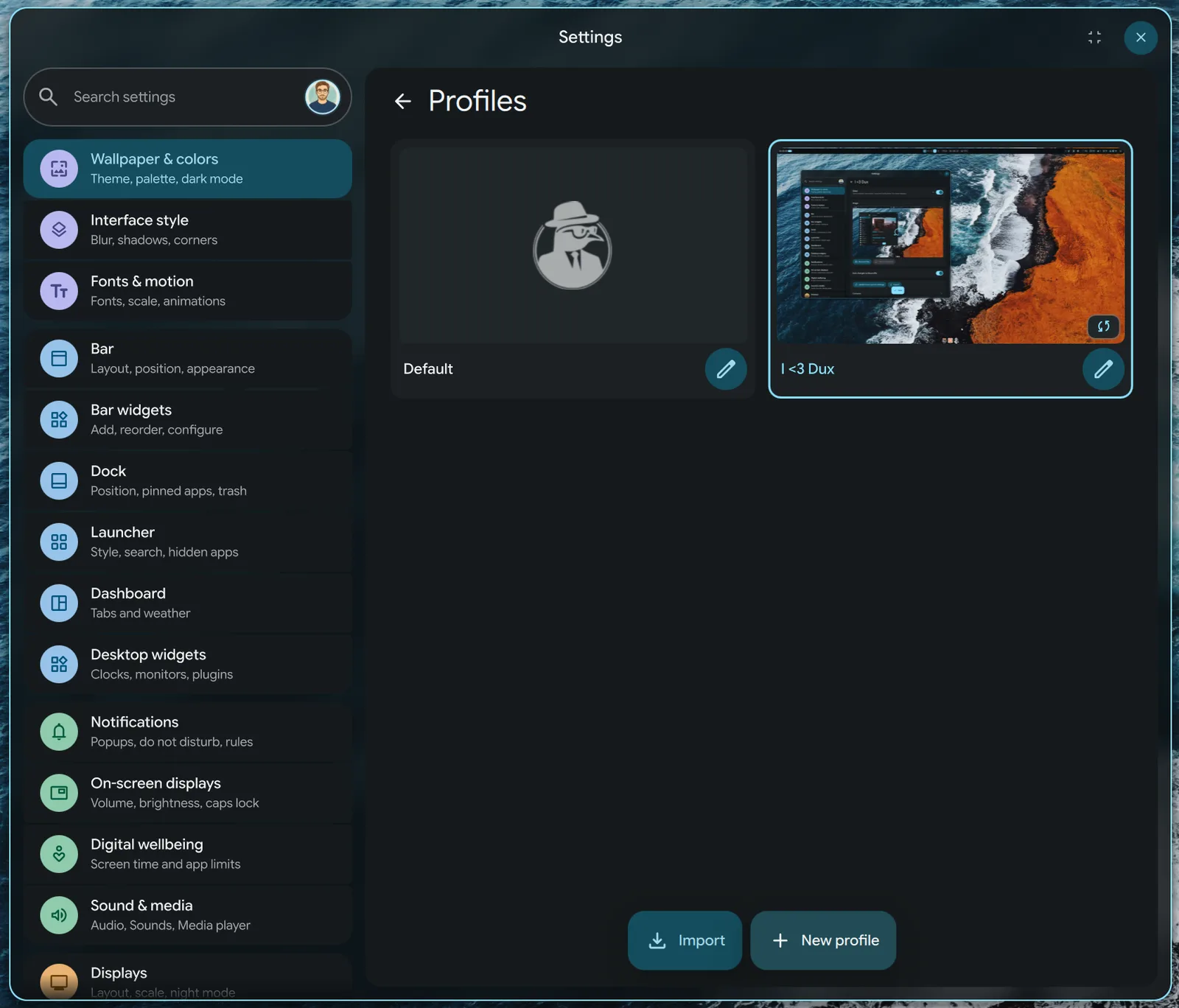
dux-shell#3867Save and switch between sets of settingsMerged
merged Nov 14, 2026+4,168 −272 reviews
Config profiles are copies of the settings to switch between: for different workloads, as a one-click backup of a working setup, or exported to share a configuration. Imports are treated as untrusted, since profiles are meant to be shared.
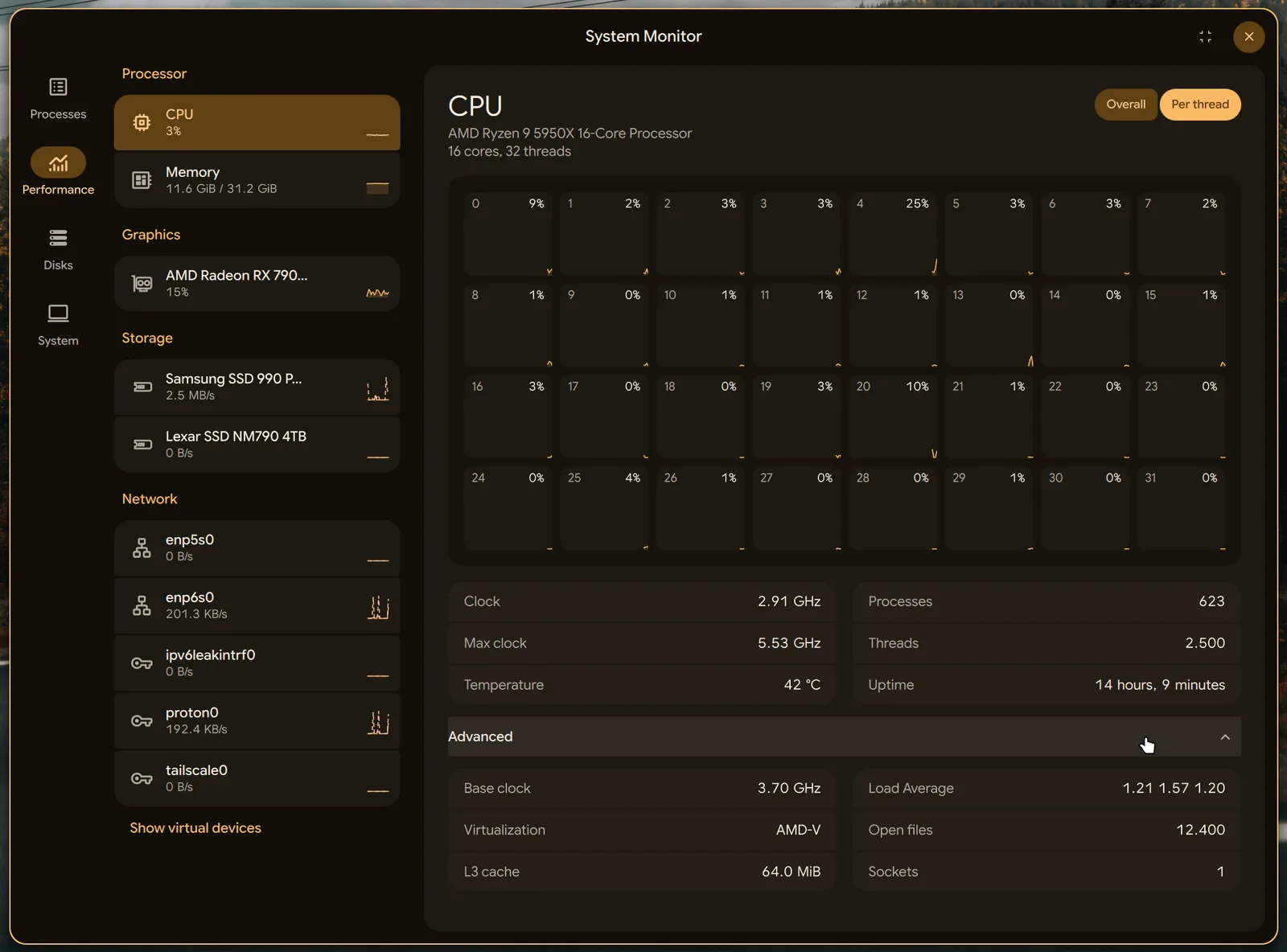
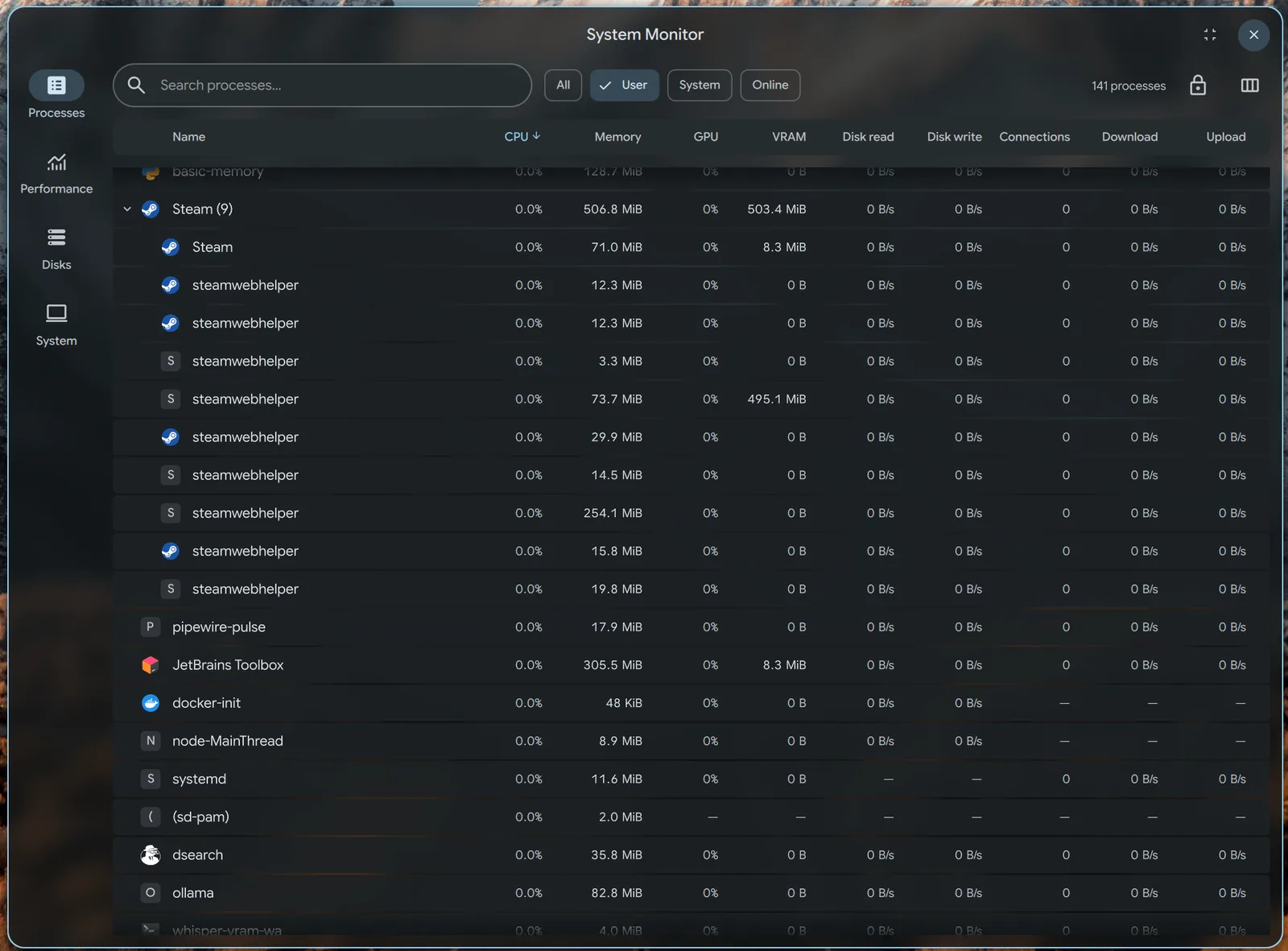
The System Monitor window has pages for processes, performance, disks and system information. Each process shows its app, its GPU and video use, its internet connections and its download and upload.
dux-gop#50Per-process GPU, disk and network data, collected fasterMerged
merged Oct 31, 2026+7,081 −4894 reviews
The data behind the new System Monitor, collected in Go: GPU, disk and network use per process, sensors and memory modules. A poll of the process list went from 375 ms to 22 ms of CPU time on my machine.
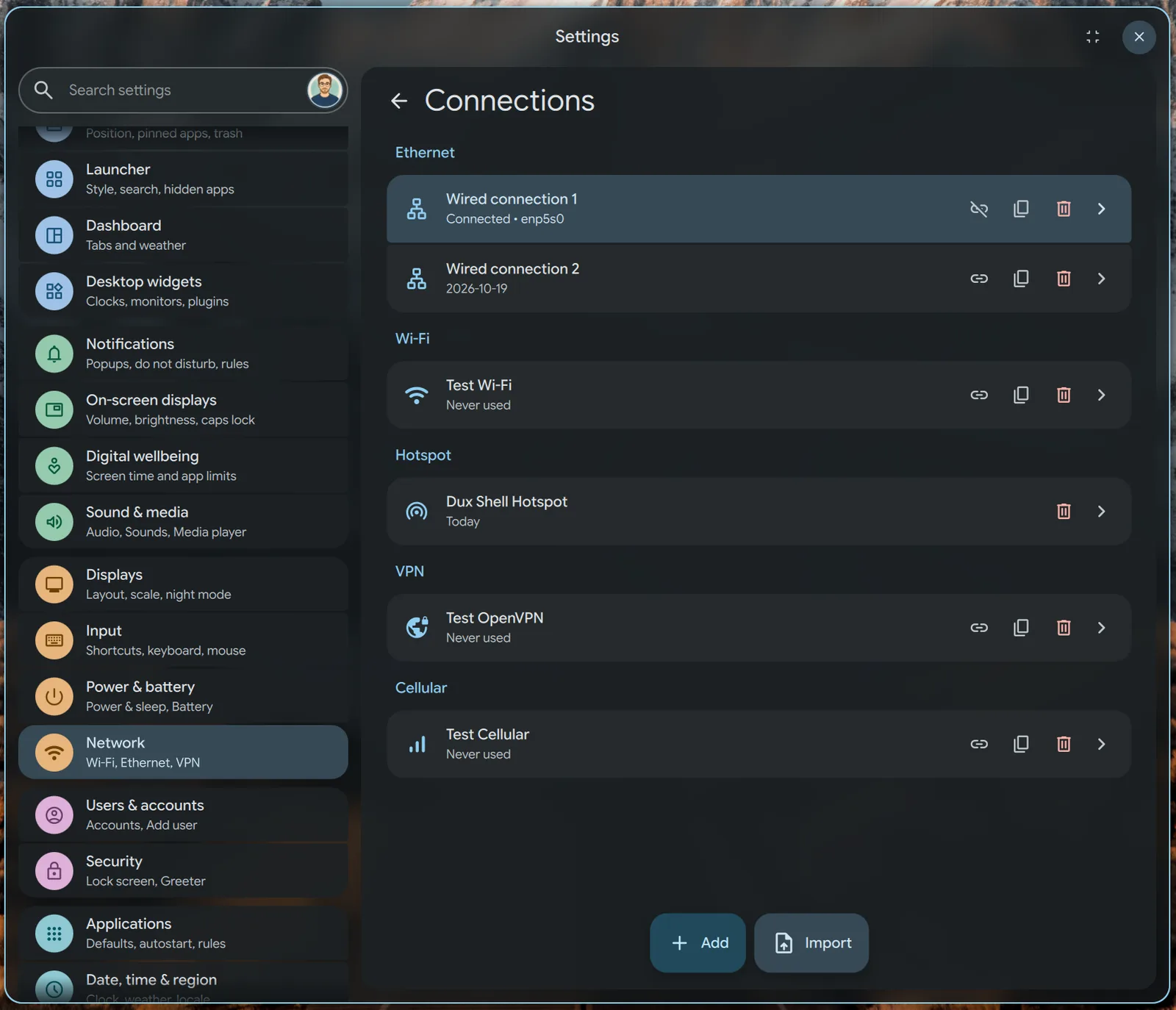
dux-shell#3727Create and edit network connections in SettingsMerged
merged Nov 14, 2026+13,060 −2,64920 reviews
Network connections can be created and edited in Settings: Ethernet, Wi-Fi, VPN and more, including enterprise networks such as eduroam. It also adds a hotspot page with a QR code, a Tailscale page and a login button for captive portals.
Popouts from the bar or the island can connect to it, as in connected frame mode but without the frame around the screen.
Synced
Read more
What I did
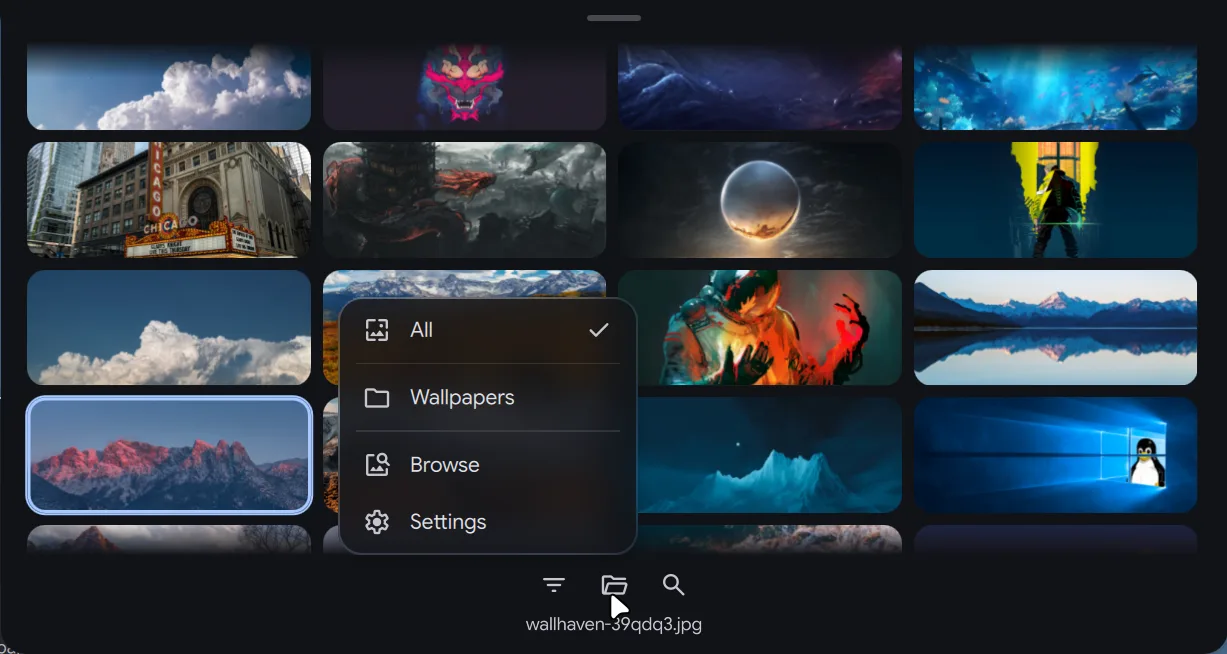
My largest features in the shell are config profiles, the reworked system monitor, the network settings and wallpaper folders. Most of them span the Go backend and the QML interface, the system monitor also dux-gop, the Go library that collects the system data, and I wrote the docs pages for profiles and the system monitor.
Most of my other pull requests fix bugs: in the shell, in dux-gop and in the QML components shared by the Dux apps.
Beyond code, I report bugs with their root cause, help users in the support channels, take part in design discussions, such as where profiles sit in Settings, and work with the maintainers on larger features.
A Claude Code plugin that takes an idea to merge-ready code: a brainstorm, a test-driven plan, parallel implementation in git worktrees with a review for each task, documentation and a security review. Hooks block destructive commands, so the stages run without prompts.
Manual approval gates after the spec and the plan, and a final gate before the merge. The rest runs on its own.
The planner gives every task its own files and orders the tasks in waves by dependency, so agents implement a wave in parallel git worktrees without merge conflicts.
Every task gets its own review. Blocking findings go back to the implementer, and if fixes keep failing, the debugger and then the planner step in.
Security hooks deny destructive commands and reads of secrets and ask before risky ones, which lets a run go unattended.
I use it daily on my own projects.
Claude Code, Agents, Hooks, Git3 starslatest release devline--v0.4.7
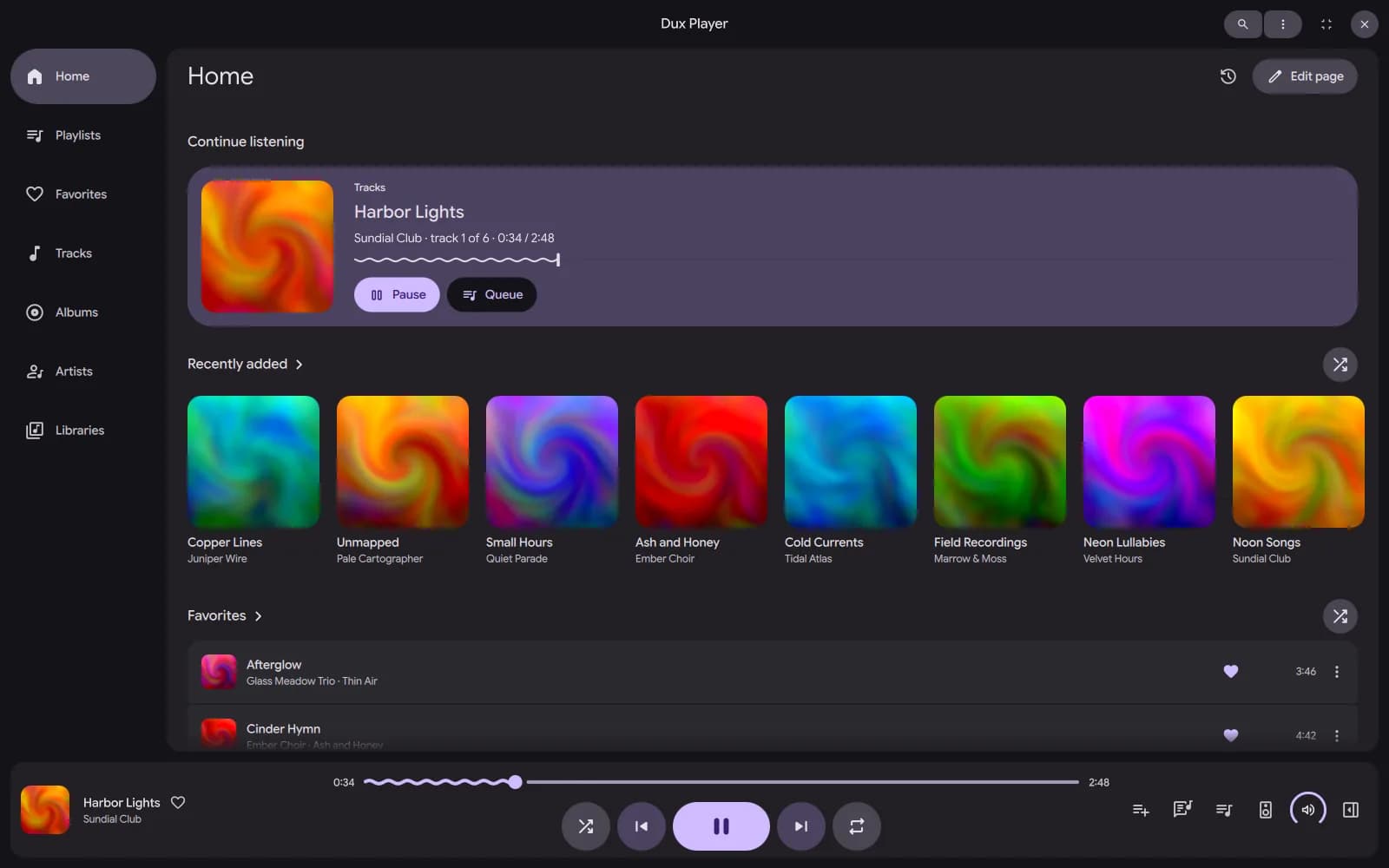
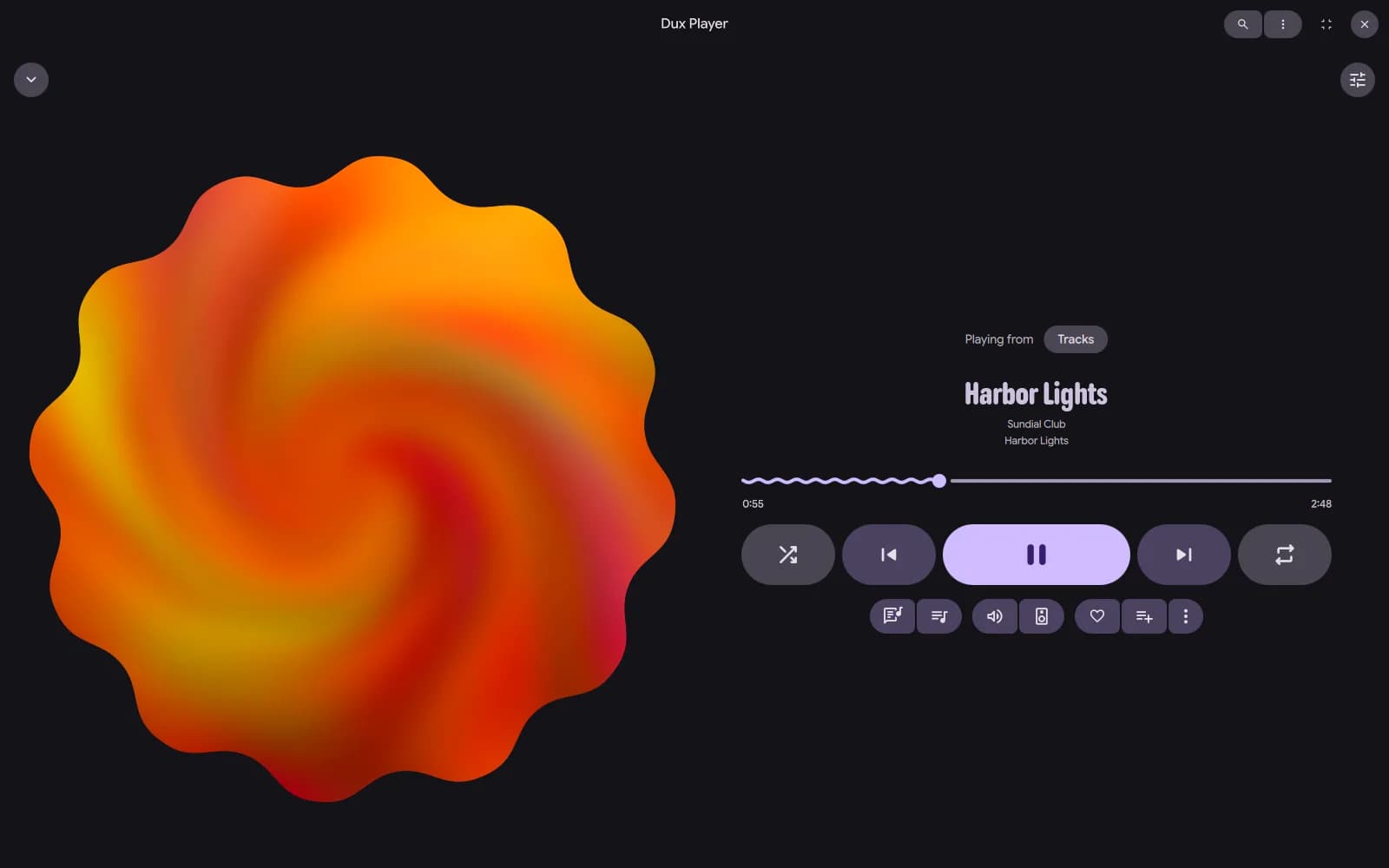
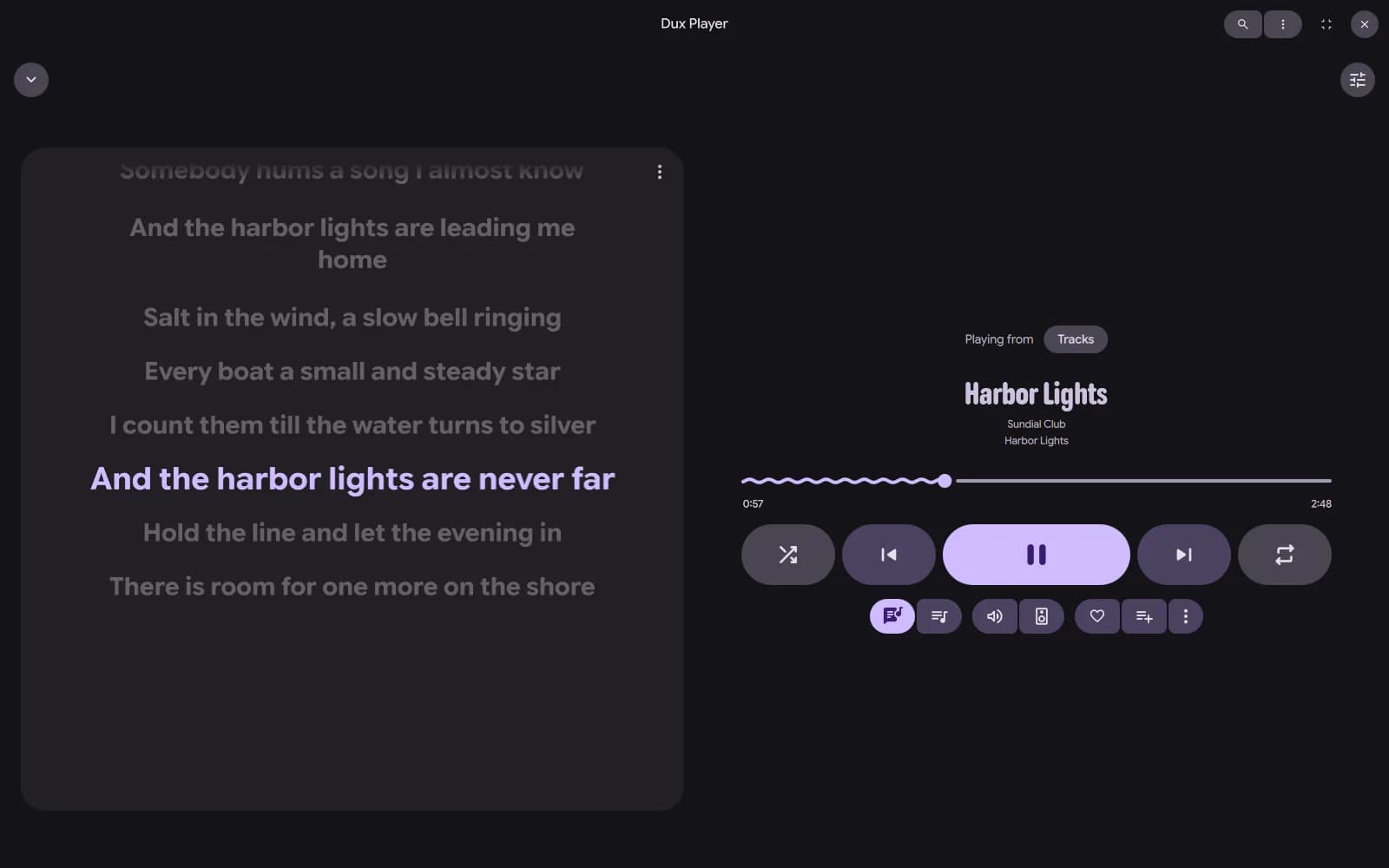
A music player for Linux in the style of Dux Shell: it runs natively in the shell, with its settings and theme, or standalone in any other shell. It plays local libraries and streams from Navidrome, Subsonic and Jellyfin servers. Lyrics are fetched automatically and matched to the song, their timing is aligned to the audio, and they fill in word by word. The bar, side panel and full view come in a Bento and a Material style, and it casts through dux-cast, the helper behind the Cast plugin. Still in alpha.
Plays local folders, indexed and watched, and any number of Navidrome, Subsonic and Jellyfin servers. Rules keep server tracks on the device, and the server catalogs are stored locally. Browsing and search keep working while a server is unreachable.
Fetches lyrics from the server or from online sources such as LRCLIB, matches them to the track, aligns their timing to the audio and fills them in word by word, in the full view and as one line in the bar.
Plays gapless, with crossfade, volume normalization, an equalizer and skipping of silence at the start and end of a track. When the queue ends, the player stops or keeps going with random or similar tracks, picked to be familiar, balanced or adventurous.
Three player modes, the now-playing bar, the side panel and the full view, each in a Bento or a Material style, with elements the user arranges. Pages, columns and filter rules can be customized, colors can follow the cover, and the settings are searchable.
I build the player on my own: a Go daemon for playback, the library and the servers, and a QML interface on Quickshell. Casting goes through dux-cast, the same helper the Cast plugin uses.
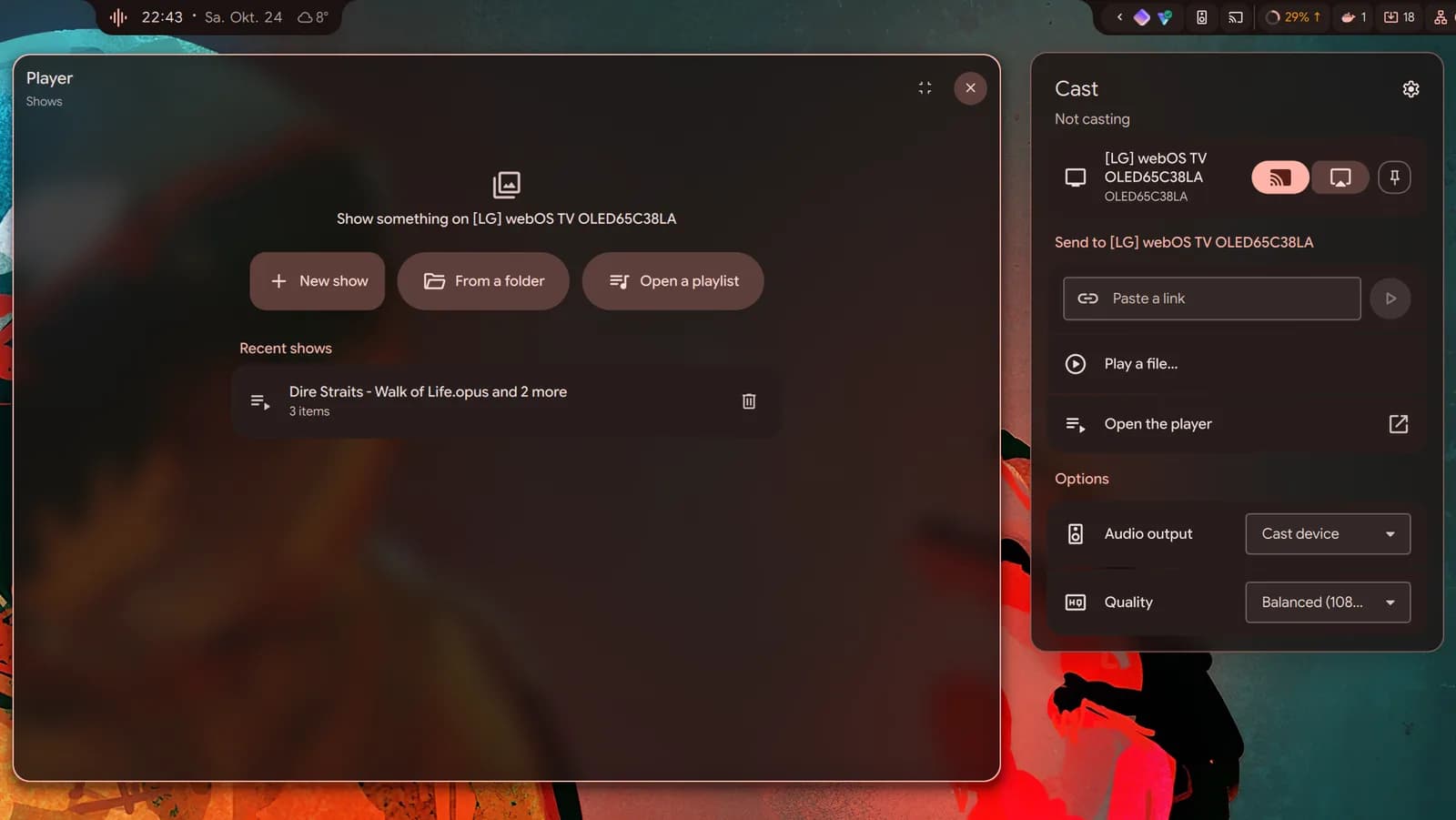
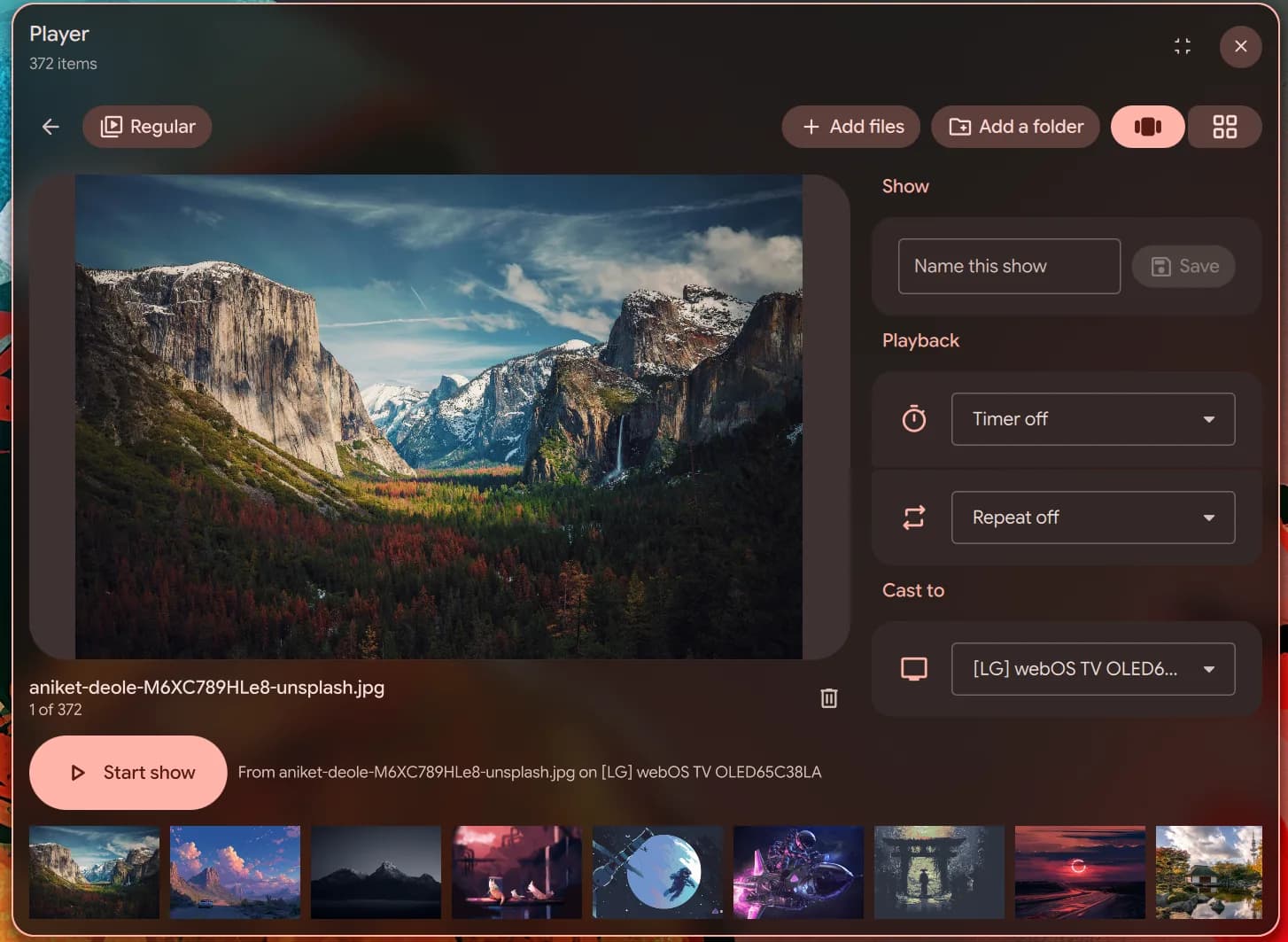
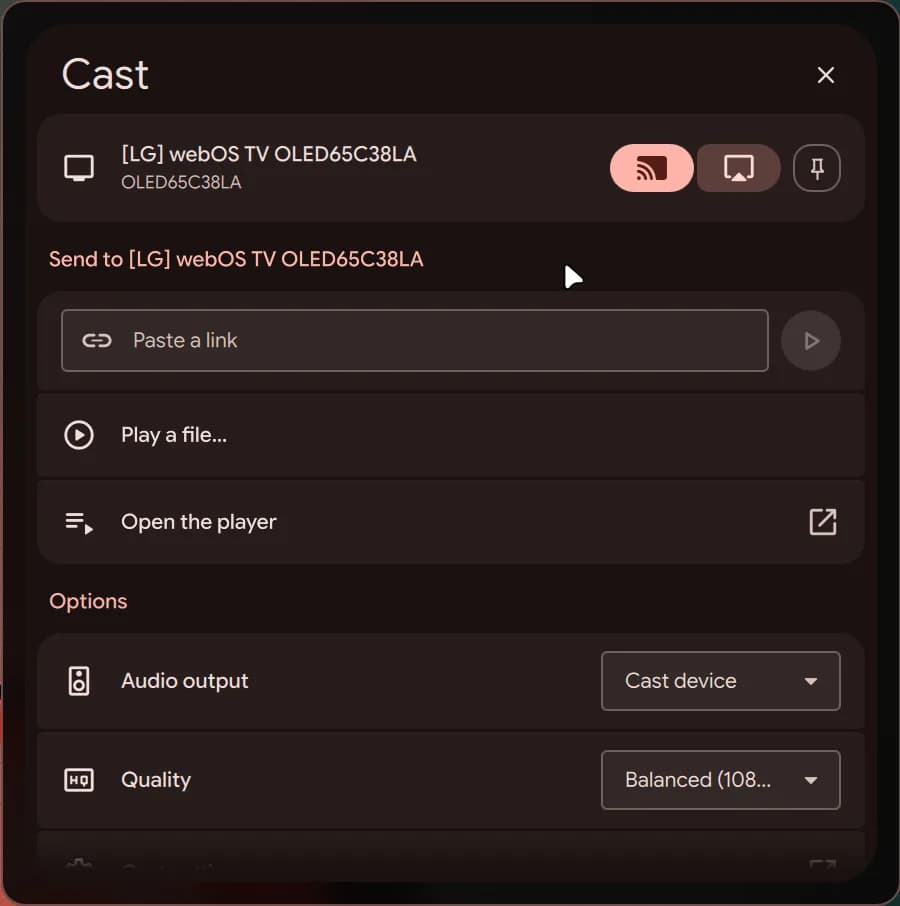
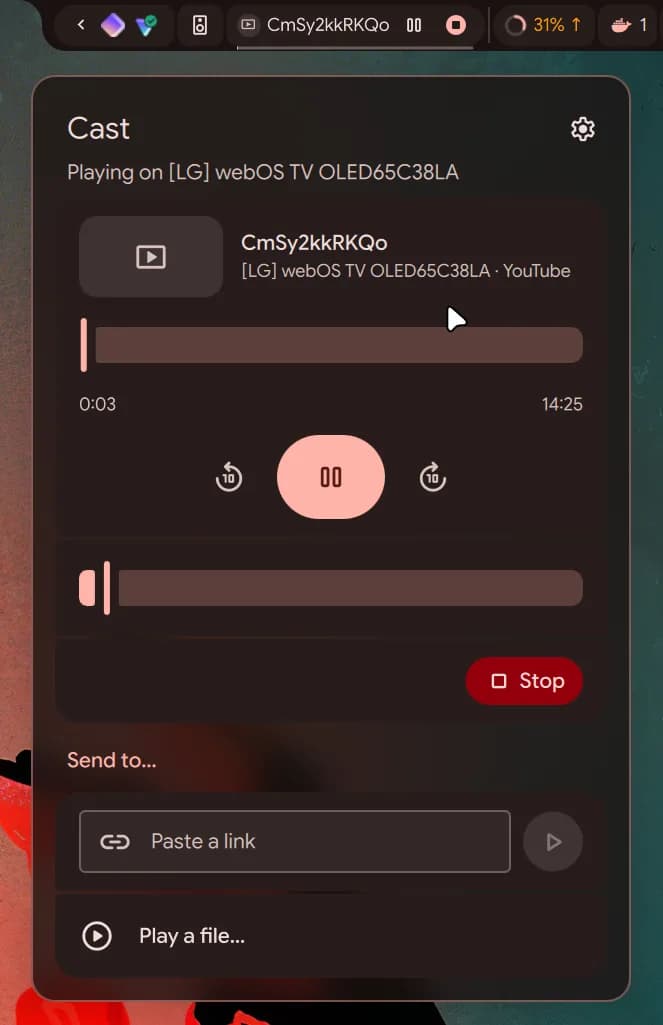
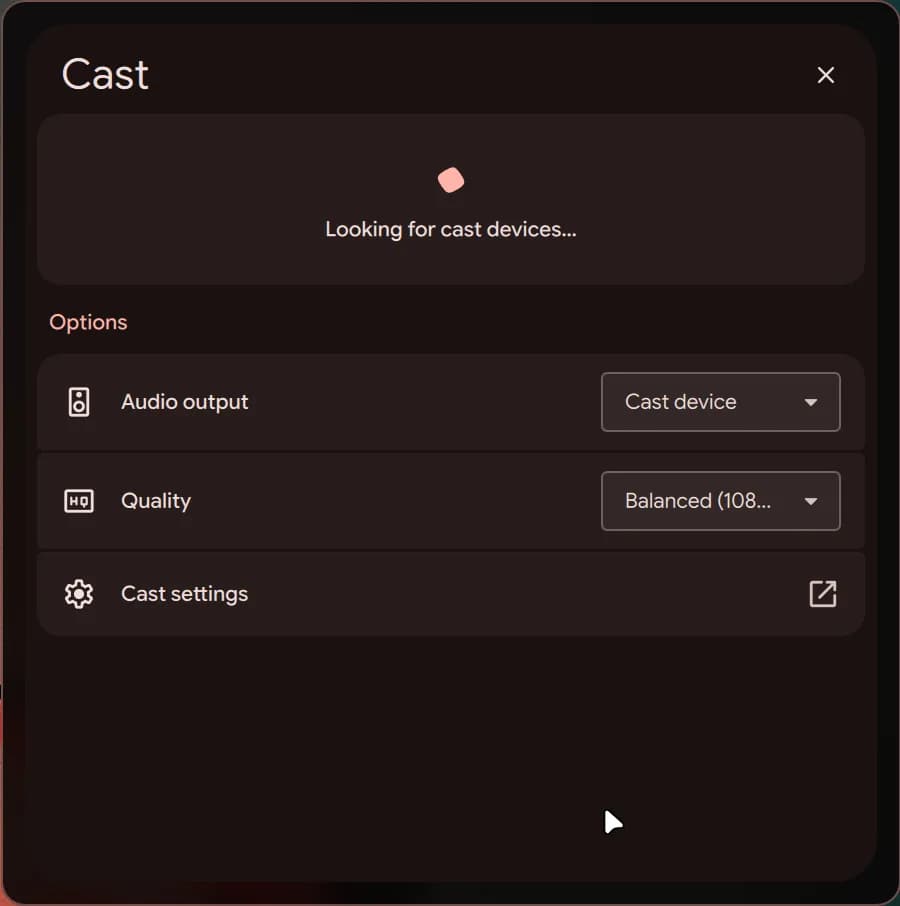
Plugins for Dux Shell. The Cast plugin mirrors the screen to Chromecast, Google TV and AirPlay devices and plays files, music, playlists and slideshows. Its device handling is dux-cast, a helper program that Dux Player casts through as well.
The helper program behind the Cast plugin and behind casting in Dux Player. It casts the screen, files, music and links, and other applications can use it as well.
Three Maven modules: a game engine with no dependencies, a JavaFX desktop client and a TCP server. Client and server depend only on the engine.
The server runs up to 40 games at once by default, checks every move with the same engine before relaying it, and handles login, matchmaking, join codes and reconnects. Accounts and games are stored in SQLite.
Rule variants implement one Ruleset interface, so Chess 960 went in without special cases in the game logic.
75 test classes across the three modules.
Why it mattered When I moved the client from Swing to JavaFX in March 2026, the rewrite touched only the client module. Engine and server stayed as they were.
This site: four designs (Ink, Trace, Flow and Type) over the same typed content in English and German, and a BPMNscript playground that runs the language server and compiler in the browser.
Designed and built four designs over one set of content. Ink has a WebGL ink fluid, Trace a BPMN line that runs the page as you scroll, Flow a three.js scene whose forms are built from the content, and in Type you fly through the counter of a letter into the next section.
A BPMNscript playground that runs the language server and compiler in a web worker in the browser, set up as a small IDE: files, tabs, a Problems panel, a live diagram and BPMN export.
The content is typed JSON and MDX in English and German. A test fails as soon as a fact (a date, URL or number) differs between the two languages.
End-to-end tests run against the production server, and a visual harness screenshots every design and fails on page errors, overflow or scroll jank.
A scripting language for the JVM that I built to learn how interpreters work: an ANTLR4 grammar and a tree-walking interpreter in Java, with classes, methods and lists.
A Linux VPS and a Raspberry Pi at home that I set up and run myself: Docker, Traefik, my own DNS, a mesh VPN between all my devices, backups and monitoring.
A Linux VPS runs my everyday services in Docker behind Traefik: Nextcloud, a Matrix server with voice and video calls, Navidrome for music, the analytics for this site and the backends of my projects.
A Raspberry Pi at home is the network's DNS server, with ad and tracker blocking for every device, plus a network share on an encrypted drive and containers that can only reach the internet through a VPN tunnel with a kill switch.
All my devices are in one mesh VPN that I host myself (Headscale), so the home DNS and services work from anywhere.
Docker networking is set up per service: databases sit on internal networks without access to the proxy, and the home services get wildcard certificates through a DNS challenge served from the VPS.
Nightly backups go to a storage box and an encrypted copy to a second provider; uptime monitoring sends push notifications when a service goes down.
This site deploys there: GitHub Actions builds the image, pushes it to GHCR and restarts the container over SSH.