Overview
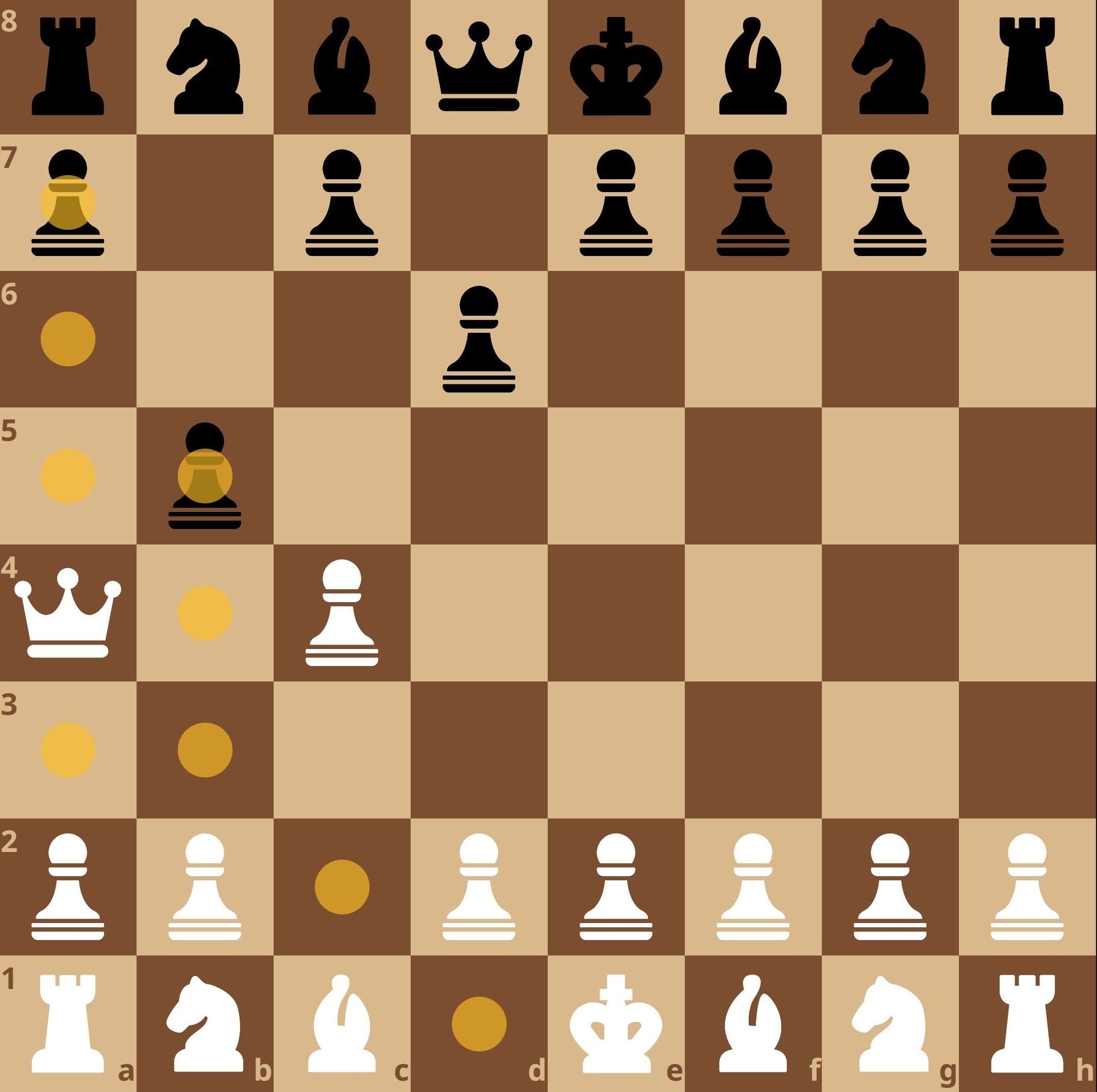
A three-module Maven project (Java 17 + JavaFX 21) that implements a complete chess platform: a desktop client with a cinematic animated menu, a pure-logic game engine supporting Standard Chess and Chess 960, and a TCP multiplayer server with authentication, matchmaking, and game persistence. The modules have strict dependency boundaries — core has zero external dependencies, and neither the client nor the server knows about the other.
I started this during my second year at university. It has gone through several major rewrites since then, most recently a full migration from Swing to JavaFX and an overhaul of the server into a persistent system with user accounts and session management. Today it also doubles as my testbench for agentic AI development workflows — I use it to evaluate how well spec-driven and test-driven approaches work on a real codebase.

Features
- ▸Local play for two players on the same machine
- ▸Online multiplayer with a TCP lobby, join codes, and automatic matchmaking
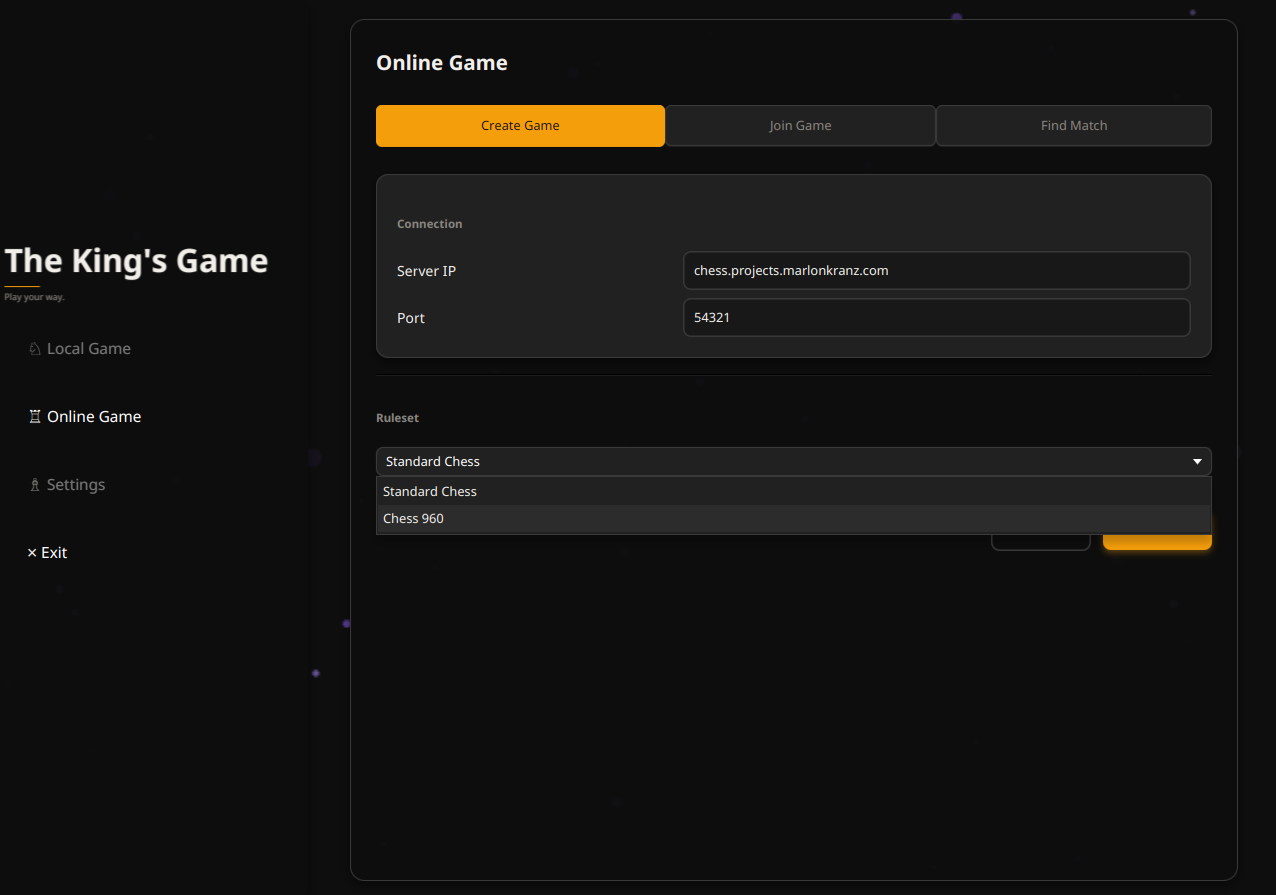
- ▸Standard Chess and Chess 960 rulesets, selectable per game
- ▸Pawn promotion with an interactive piece-selection dialog
- ▸Castling (king-side and queen-side) with move-history validation
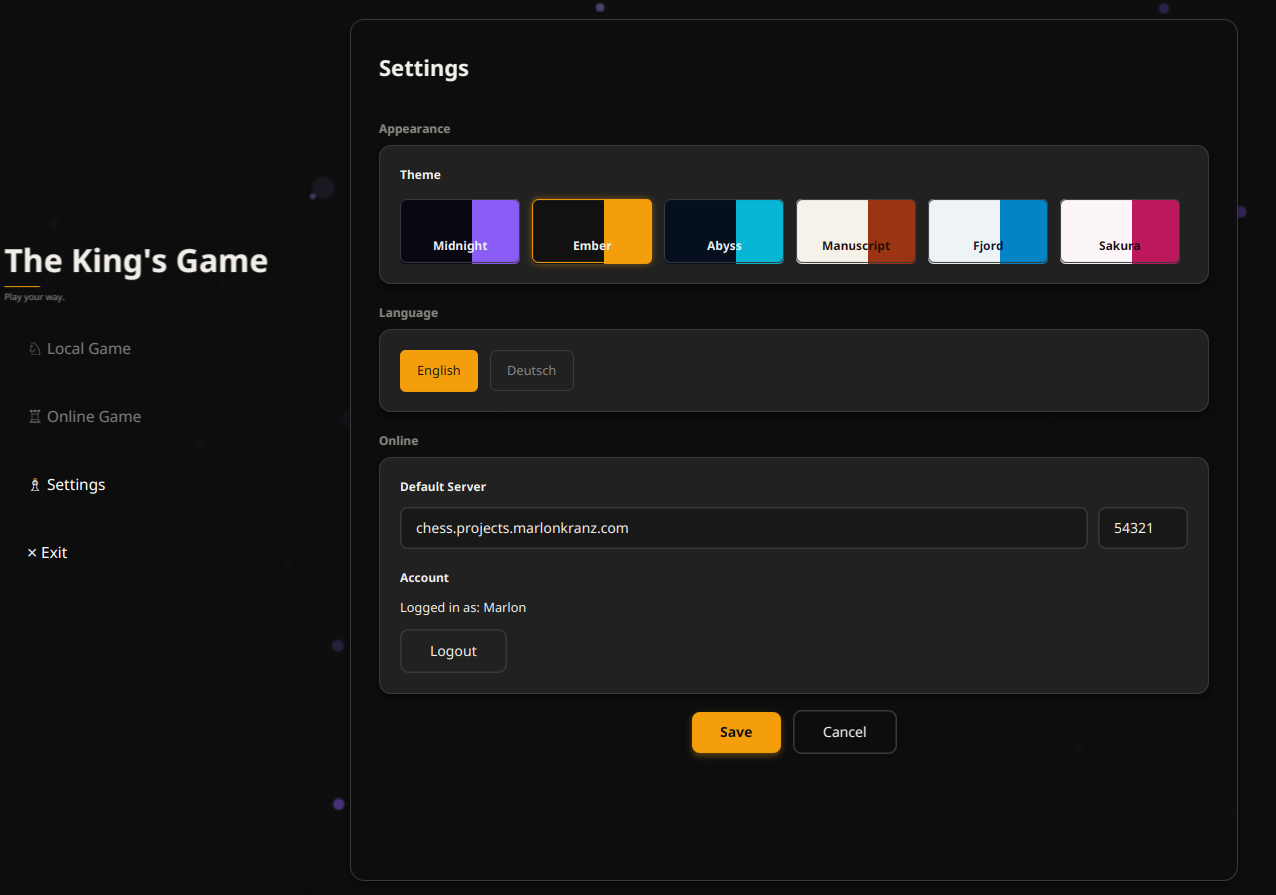
- ▸6 visual themes — Midnight, Ember, Abyss (dark) and Manuscript, Fjord, Sakura (light)
- ▸English and German localization via
ResourceBundle - ▸Headless API mode for programmatic game control (
noguiflag) - ▸Server handles up to 40 concurrent games
Architecture
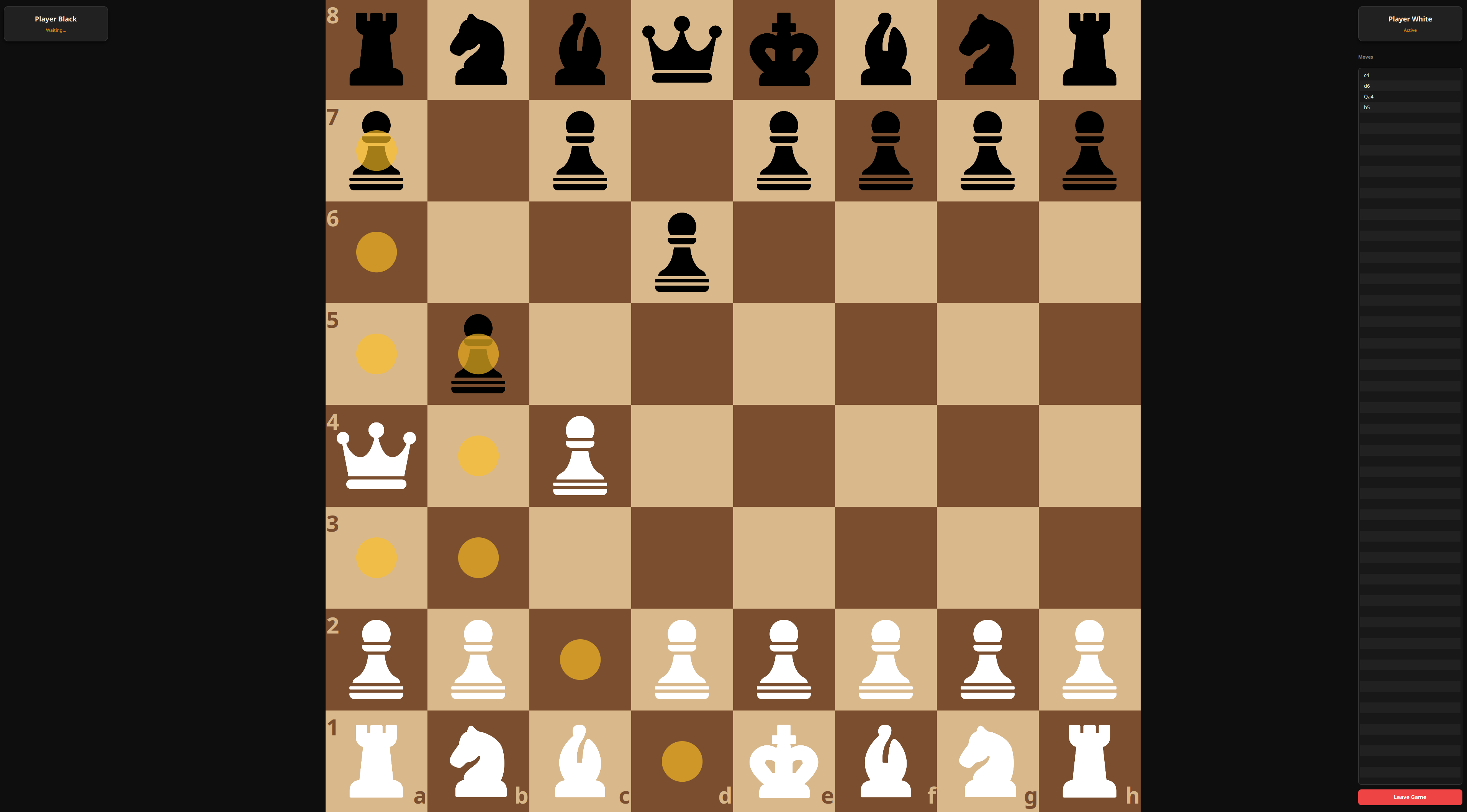
The project is split into three Maven modules with strict dependency rules:
Architecture rules enforced across all modules:
- ▸
corehas zero dependencies onapplicationorserver. The client and server depend oncoreonly, never on each other. - ▸All external interaction with the game engine goes through the
Chess.javafacade. Direct instantiation ofGamesubclasses from outsidecoreis not allowed. - ▸UI components implement
GameObserverand register viachess.addObserver(). No polling. - ▸
coreis pure logic — no UI imports, no JavaFX, no I/O. - ▸New rule variants implement the
Rulesetinterface. No branching insideGamefor different rules.
Design patterns
| Pattern | Implementation | Purpose |
|---|---|---|
| Facade | Chess.java | Single API surface for all game interaction |
| Observer | GameObserver / Observable | Decoupled, push-based state propagation to UI |
| Strategy | Ruleset interface + StandardChessRuleset, Chess960Ruleset | Pluggable rule variants without conditionals |
| Factory Method | Game.createGame() / Game.createServerGame() | Enforces module boundaries; keeps constructors package-private |
| Template Method | Game.executeMove() | Defines move sequence; OnlineGame overrides for network relay |
Multiplayer server
The server accepts TCP connections on a configurable port (default 54321). Each client gets its own thread. Games run as isolated GameInstance sessions.
- ▸Up to 40 concurrent games (semaphore-limited)
- ▸Join codes: 12-character alphanumeric (
XXXX-XXXX-XXXX), generated withSecureRandom, auto-expire after 10 minutes - ▸Automatic matchmaking queue alongside manual join codes
- ▸User authentication with SQLite-backed persistence
- ▸Newline-delimited plain-text protocol
- ▸Automatic resignation on disconnect
Testing
75 test classes across all three modules:
| Module | Tests | Focus |
|---|---|---|
core | 34 classes | Board state, pieces, move generation, observer notifications, rulesets (Standard + Chess 960), castling, game factory |
application | 31 classes | Facade API, i18n, settings, theme manager, cinematic menu components, CSS validation |
server | 10 classes | Server lifecycle, config, game management, client handler, matchmaking, authentication, persistence |

As an AI development testbench
This project is also where I test agentic AI workflows. The codebase has enough complexity to be a real test (three modules, strict architecture rules, 75 test classes) but I can still iterate quickly. Experiments I've run:
- ▸Full UI migration from Swing to JavaFX, planned and executed through spec-driven agentic workflows using devline
- ▸Large-scale technical debt cleanup across all modules
- ▸Architectural restructuring to enforce module boundaries through AI-generated refactoring plans
Each experiment tests a different approach (spec-first, test-first, review loops) and I evaluate results against the architecture rules and test suite.
Tech stack
| Layer | Technology |
|---|---|
| Language | Java 17 |
| UI | JavaFX 21 (FXML + CSS theming) |
| Build | Maven (multi-module) |
| Testing | JUnit 5, Mockito |
| Networking | Java standard library (ServerSocket, ConcurrentHashMap, Semaphore) |
| Persistence | SQLite (server-side user accounts and game data) |
| Localization | ResourceBundle (EN/DE) |
| Theming | CSS (6 themes: 3 dark, 3 light) |